Problem: Choosing the right stainless steel can be confusing due to the differences in grades and their applications.
304 and 316 stainless steels have unique properties that make them suitable for specific uses. Learn which suits your needs best.
Stay with me to discover the strengths and weaknesses of these two popular stainless steel grades.
Which stainless steel is better, 304 or 316?
Deciding between 304 and 316 stainless steel depends on your specific application and environmental conditions.
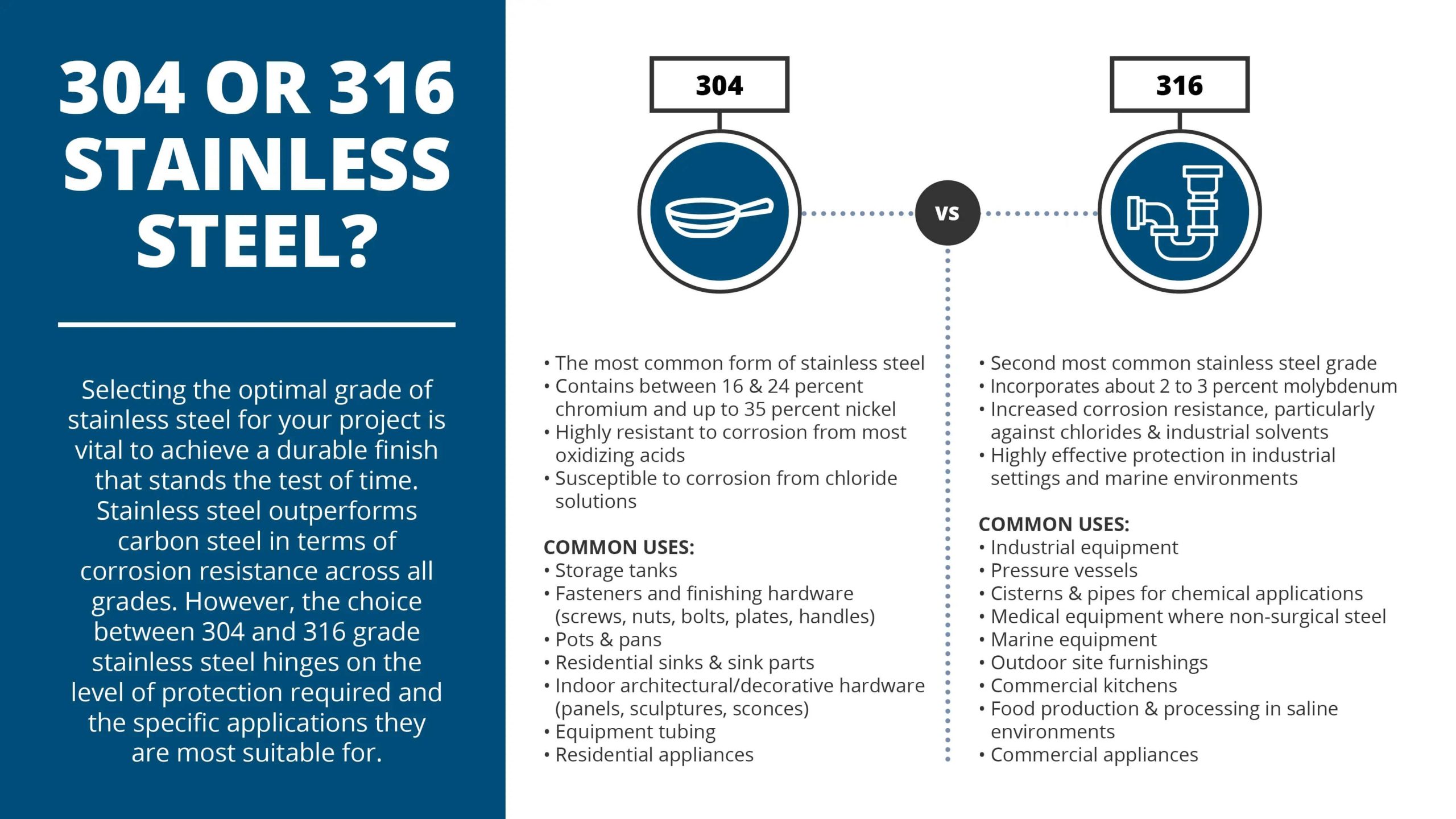
304 stainless steel[^1] is cost-effective and versatile, while 316 stainless steel[^2] offers better corrosion resistance, especially in harsh environments.
Dive Deeper into the Comparison of 304 and 316 Stainless Steel
304 and 316 stainless steels are both part of the austenitic family, making them highly durable and corrosion-resistant. However, their chemical compositions set them apart.
Key Differences in Composition
| Property | 304 Stainless Steel | 316 Stainless Steel |
|---|---|---|
| Main Alloying Element | 18% chromium, 8% nickel | 16% chromium, 10% nickel |
| Added Component | None | 2-3% molybdenum |
316’s molybdenum content[^3] significantly enhances its ability to withstand chlorides and harsh chemicals, making it ideal for marine and industrial applications. On the other hand, 304 is the economical choice for general use.

What are the disadvantages of 316 stainless steel?
316 stainless steel excels in many areas, but does its superior performance justify the cost?
While 316 is durable and resistant to corrosion, it is more expensive and less readily available than 304[^4].
Dive Deeper into the Drawbacks of 316 Stainless Steel
The molybdenum addition in 316 stainless steel[^5] boosts its properties but also raises its price. Additionally, the higher cost of raw materials and processing makes it less affordable for projects that don’t require extreme corrosion resistance.
Applications Where 316 May Not Be Ideal
| Situation | Reason | Suggested Alternative |
|---|---|---|
| Low-Corrosion Environments | Overkill | 304 Stainless Steel |
| Budget-Constrained Projects | Expensive | 304 Stainless Steel |
316 is excellent for harsh conditions, but it’s not the best fit for all scenarios. Evaluating your project needs can help you make a more cost-effective choice.
Is 304 or 316 better for a kitchen?
When it comes to kitchen applications, hygiene and corrosion resistance are critical.
304 stainless steel[^6] is commonly used in kitchens due to its affordability, while 316 stainless steel[^7] is better for saltwater environments or extreme exposure.
Dive Deeper into Kitchen Applications of 304 and 316 Stainless Steel
304 is widely used for cookware, utensils, and kitchen equipment due to its excellent corrosion resistance and affordability. For professional kitchens or environments exposed to saltwater or strong acids, 316 may be the better choice.
Food-Grade Suitability Comparison
| Feature | 304 Stainless Steel | 316 Stainless Steel |
|---|---|---|
| Resistance to Corrosion | High | Very High |
| Cost | Affordable | Expensive |
| Common Use Cases | General kitchenware | Industrial kitchenware |
Choosing between the two depends on the balance of cost and the severity of environmental conditions.

What are the weaknesses of 304 stainless steel?
304 is versatile and cost-effective, but is it always the right choice?
304 stainless steel[^8] is prone to pitting and corrosion in chloride-rich environments, making it unsuitable for marine applications.
Dive Deeper into the Weaknesses of 304 Stainless Steel
While 304 stainless steel[^9] is durable and resistant to most corrosion, it struggles in environments with high salt content or exposure to harsh chemicals. Without molybdenum, it cannot withstand chlorides like 316 can.
Situations Where 304 May Fail
| Environment | Problem | Recommended Solution |
|---|---|---|
| Marine Applications | Chloride Corrosion | 316 Stainless Steel |
| Harsh Industrial Settings | Chemical Exposure | 316 Stainless Steel |
If your project doesn’t involve these extreme conditions, 304 remains an excellent, cost-effective choice.
Conclusion
In summary:
- 304 stainless steel[^10] is versatile and cost-effective, making it ideal for general-purpose use.
- 316 stainless steel[^11] offers superior corrosion resistance, especially in marine and harsh chemical environments.
- Kitchens typically use 304, but 316 excels in professional and challenging conditions.
- 304 is unsuitable for chloride-heavy environments due to pitting and corrosion risks.
- Evaluate cost, performance, and environment to select the right grade for your project.
Choose the stainless steel grade that aligns with your specific requirements for durability and budget.